
Your Body's Alternating Kinetic Chain
By Calvin Thai PT, DPT
Your Body's Alternating Kinetic Chain
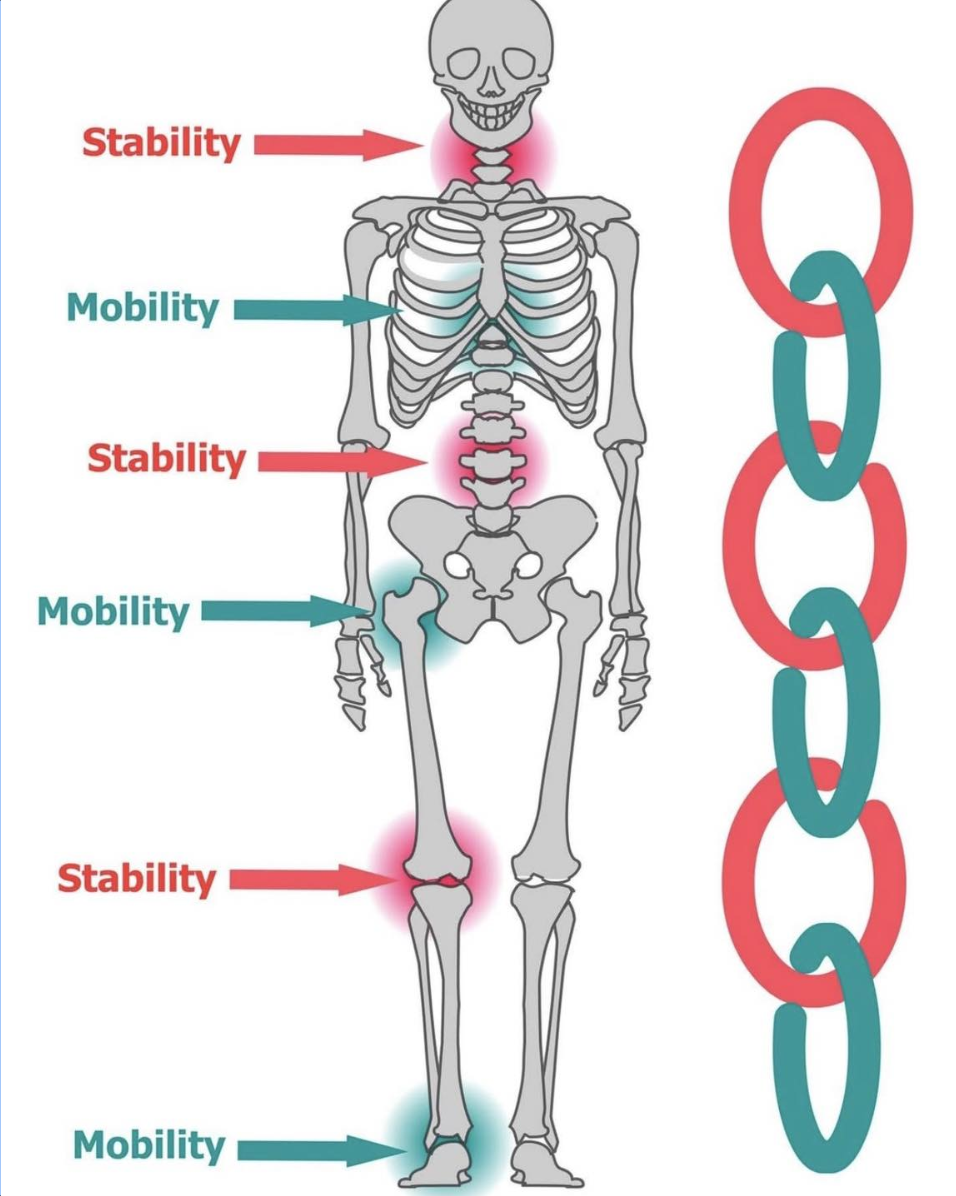
Did you know your body's anatomy alternates between stability and mobility? I remember learning this in PT school and being so confused. Like, what do you mean it alternates? How does that even happen? Is it some sort of subconscious decision or something?
Quick anatomy lesson: there are three parts to your spine: the cervical, thoracic, and lumbar regions. Your cervical spine is your neck, and it's responsible for supporting your head and protecting the structures that connect your brain to the rest of your body. Your thoracic spine is where your ribs attach, and its role is to help protect your lungs and heart. Your lumbar spine is your lower back, and its main job is to bear the weight of your torso and transfer energy. While all of these regions help protect the spinal cord, they are each built differently for a reason.
Each section of your body acts like a link in a chain. As you move through the chain, your body alternates between segments that prioritize stability and segments that prioritize mobility. Some areas are built to be sturdier and more supportive, while others are designed to move more freely. Starting with the cervical spine, the body tends to favor stability because it supports your head. Moving down, the thoracic spine favors mobility, while the lumbar spine shifts back toward stability. This alternating pattern continues throughout the body. This isn't a hard rule—mobile areas still need stability, and stable areas still need movement—but different regions do have different tendencies and roles.
Why does any of this matter?
Because it can explain a lot of the common injuries we see in the clinic.
Take lower back pain, for example, which is one of the most common diagnoses we treat. If we look at many desk workers, a common finding is stiffness through the thoracic spine from prolonged sitting and posture habits. But remember, the thoracic spine is an area that's supposed to contribute more mobility. So what happens when that part of the chain starts losing its function? The areas above and below it often have to compensate and pick up the slack. In many cases, we start seeing hypermobility in the lower back.
But wait, isn't the lower back supposed to be one of the more stable links?
Exactly. When a region designed for stability is forced to provide extra movement, it can become irritated over time, which may contribute to lower back pain.
That can be one explanation for why someone develops lower back pain. By understanding the anatomy and natural tendencies of the body, we can better understand why certain injuries happen in the first place. Most problems develop over time, so identifying the weak link in the chain can help us figure out what's contributing to the issue rather than simply chasing symptoms. This can even help guide the direction of rehabilitation. If an area is meant to be more stable, we can focus on improving stability there, and vice versa.
The body is really good at adapting, but sometimes those adaptations are what eventually lead to pain. Just because an area hurts doesn't necessarily mean it's the source of the problem. That's why understanding how the body is designed to move and function matters. When we can identify which links in the chain aren't doing their job well, we can stop treating only the symptoms and start addressing the actual cause of the issue.
Let’s chat! Book an assessment and let’s get you back to feeling good in your body.
No referrals, no waiting, just answers. Did you know that we offer free 1-on-1 injury screens? Wattage Physical Therapy will take an in depth look at your ergonomics, posture, muscle tone, muscle weaknesses, and movement patterns to create a plan for YOU. If this article intrigues you, you can directly email me, Calvin at calvin@wattagept.com. I would be happy to help you start the process of living a life free from pain.